How to Choose Paper Receipt Rolls in 2026?
Choosing Paper Receipt Rolls in 2026 is a practical decision, not just a matter of picking the cheapest box. A roll that fits the printer but jams at the counter can slow every sale. Check the width, diameter, core size, and paper length against your printer’s specifications. Then consider print clarity, roll consistency, and how the paper performs in a busy checkout area. Small details matter. A loose core or uneven edge can cause trouble.
The expert name and quotation below are illustrative, not a verified real-world attribution. In this guide, paper-converting specialist Alex Morgan’s guiding principle is: “A good receipt roll should fit cleanly, print clearly, and keep working through the rush.” Use that as a checklist, not a guarantee. Different printers and store conditions can produce different results, and a sample roll is worth testing before a large order. Look closely at a freshly printed receipt: Are the numbers sharp? Does the paper feed smoothly? Does the roll last through a typical shift? There is no perfect choice for every business. This guide will help you compare specifications, match rolls to your equipment, and weigh price against dependable performance. A little trial and error may remain. That is worth admitting.
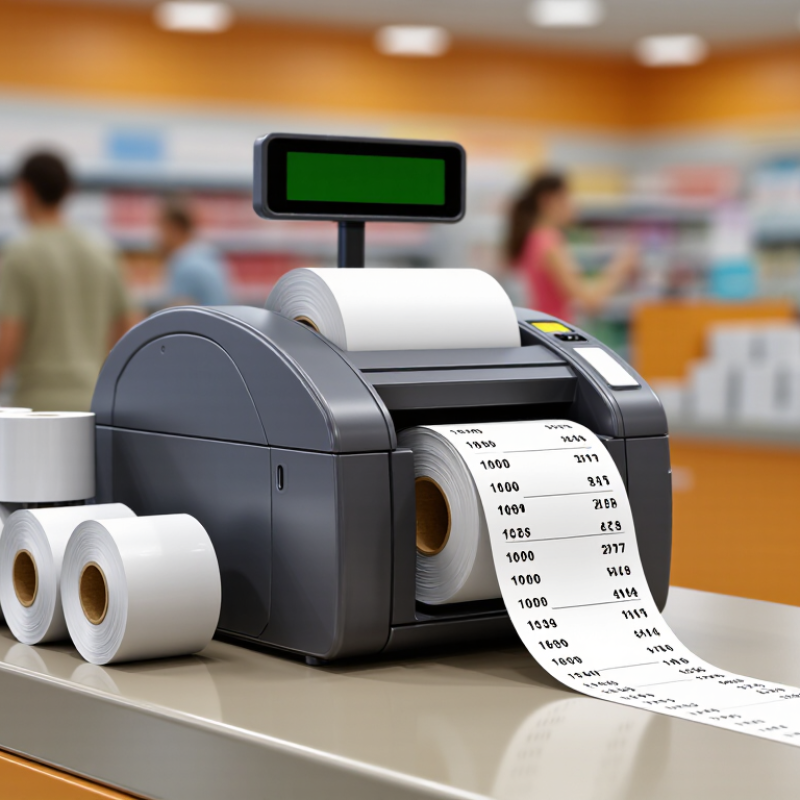
Match Roll Width to Printer: 57 mm and 80 mm Are Common Sizes
Receipt roll width should match the printer’s stated paper capacity, not just look close to the old roll. The common options are 57 mm and 80 mm. A 57 mm roll suits compact counters and handheld terminals, while 80 mm paper gives more room for item descriptions and payment details. That small mismatch matters.
Check the printer label or manual before ordering. Measure the paper across its flat width, not the roll’s diameter. A roll can look right from the side and still be too wide for the feed path. Not always obvious. Also check the permitted outer diameter and core size; a wide roll may fit the slot but jam if it is too large. If the old packaging is gone, compare a sheet with the printer’s specifications rather than guessing.
For a busy checkout, a test roll can reveal problems quickly. Feed a few receipts and look for curled edges, faded printing, or paper rubbing against the housing. Width is only one detail: the printer must also support the paper type, such as thermal paper. It is easy to focus on the millimetres and miss that. Specifications can vary between similar-looking machines, so confirm the exact model before buying in bulk.
Check Paper Weight Using ISO 536: Thermal Rolls Commonly Range 48–80 g/m²
When choosing paper receipt rolls in 2026, check grammage rather than judging a roll by feel alone. ISO 536 specifies how to determine paper grammage, expressed in grams per square metre (g/m²). Thermal receipt paper commonly falls between 48 and 80 g/m², but the right point in that range depends on the printer and daily workload. Light rolls can suit high-volume counters where frequent roll changes are acceptable. Heavier stock may feel firmer during loading and handling. A heavier sheet is not automatically more durable.
Check the product specification or test data for the stated grammage and its tolerance. A kitchen scale can offer a rough comparison, but it does not replace controlled ISO 536 testing. One important distinction: grammage is not thickness. Two papers with similar g/m² can behave differently because of their base paper and thermal coating. Look at print contrast, feed reliability, and how receipts hold up in ordinary storage. Keep a sample near the register, and test it through a full roll if possible. Small details matter. I would not choose on grammage alone; that shortcut can miss coating or printer issues. Ask for a data sheet, then check the roll in the machine it will actually serve.
How to Choose Paper Receipt Rolls in 2026? — Check Paper Weight Using ISO 536: Thermal Rolls Commonly Range from 48–80 g/m²
Use grammage as one selection factor. The ranges below are practical examples, not printer specifications; always check the printer manual and the paper supplier’s product details.
| Paper Weight (g/m²) |
Typical Considerations |
Possible Use |
What to Check Before Buying |
| 48–50 |
Lightweight option; the roll may contain more length for a given roll diameter, depending on paper thickness and winding. |
Receipts where compact roll size or longer roll length is a priority. |
Confirm the printer supports the paper’s thickness, coating, and roll dimensions. Check that the paper feeds reliably in the device. |
| 51–60 |
Common lightweight-to-medium range for thermal receipt papers. |
Everyday point-of-sale receipts and transaction records. |
Match roll width, maximum roll diameter, core size, and paper direction to the printer specification. |
| 61–70 |
Medium-to-heavier paper; grammage alone does not determine stiffness or print performance. |
Applications where a firmer-feeling receipt is preferred, provided the printer accepts it. |
Check feed compatibility and test print quality. Confirm the paper is suitable for the printer’s thermal system. |
| 71–80 |
Heavier end of the stated range; the paper may feel more substantial, but roll capacity depends on its thickness and the printer. |
Receipts for which a heavier paper feel is desired and supported by the equipment. |
Verify the printer’s permitted paper weight or thickness, roll diameter, and loading requirements before ordering. |
Confirm Core and Roll Diameter Against Printer Specifications
How to Choose Paper Receipt Rolls in 2026?
A roll may fit the printer’s width and still fail to load. Check the printer manual for the required core diameter and maximum roll diameter. The core is the hollow tube at the center; the roll diameter is the full measurement from edge to edge. Small details matter.
Measure the core opening, not the tube’s outside edge. A core that is too narrow may not sit on the holder, while an oversized opening can wobble during feeding. Then compare the full roll diameter with the printer’s stated limit. A roll that is too large may press against the cover or prevent it from closing. Measure twice. A ruler can help, but a caliper gives a clearer reading for the core.
Specifications are the safest starting point, especially when a printer uses a removable spindle or adapter. Check whether the listed diameter refers to the paper roll itself, and confirm that the holder can support the core size. If the manual is unclear, compare a known-fitting roll or ask the equipment supplier to confirm the measurements. It is easy to focus on price and paper length instead. That shortcut can lead to rolls that look right but do not feed smoothly. Allowing a little clearance is sensible, though guessing the fit is not.
Check BPA Compliance: EU REACH Sets a 0.02% Thermal-Paper Limit
How to Choose Paper Receipt Rolls in 2026?
When choosing receipt rolls, check more than width, diameter, and printer compatibility. The coating matters too. Thermal paper reacts to heat, so its chemical composition can affect purchasing decisions and workplace handling. A roll may print clearly but still lack adequate compliance documentation. Small detail. Real consequence.
EU REACH restricts placing thermal paper containing 0.02% BPA by weight or more on the EU market. That equals 200 milligrams per kilogram. Ask suppliers for a current written declaration that identifies the substance and confirms the paper meets the limit. Where available, request supporting test results, including the test method and sample date. A vague “BPA-free” label is not the same as a complete compliance record. Also ask what developer chemicals are used instead; replacing one substance does not automatically answer every safety question. Documentation can be incomplete, so review it carefully.
Tips: Match roll dimensions to the printer, then keep compliance records with purchasing documents. Check the paper specification when suppliers change. If a certificate is old or unclear, ask for clarification before ordering. A quick review now can prevent avoidable confusion later.
How to Choose Paper Receipt Rolls in 2026? Check BPA Compliance
EU REACH restricts BPA in thermal paper at concentrations equal to or greater than 0.02% by weight.
The bars show illustrative example concentrations, not measurements of specific products. Under REACH Annex XVII, Entry 66, thermal paper must contain less than 0.02% BPA by weight. Ask suppliers for documentation confirming compliance.
Source: REACH Annex XVII, Entry 66. Concentration values in the chart are illustrative.
Compare Coating and Image-Life Needs for the Intended Storage Period
How to Choose Paper Receipt Rolls in 2026?
Match the roll’s coating to how long the receipt must remain readable. A café receipt used for a few weeks has different needs from a warranty record kept for years. Direct thermal paper forms an image through heat, so sunlight, warm storage, plasticizers, and friction can all cause fading or darkening. Keep sample receipts in the actual filing conditions, not just beside the printer.
Small detail. It matters.
For a useful comparison, industry technical data sheets commonly list image-life claims of about 5–7 years for standard grades and 10–25 years for archival grades, under specified conditions. These are product claims, not a pooled independent study, and actual life can differ. ISO 18936:2012 describes accelerated heat testing for image stability; it helps compare performance but does not promise a fixed number of years in a drawer. Ask suppliers for test conditions, including temperature, humidity, light exposure, and legibility criteria.
Choose a coating around the storage environment. A back-office file near a sunny window needs more protection than a receipt stored in a cool, closed cabinet. If records must stay readable for a defined period, test printed samples over time and check both text and background discoloration. I would not select a roll from “archival” wording alone. That label can sound reassuring, but the storage assumptions may not match your workplace.