Top Thermal Roll Printer Manufacturers in China
Thermal Roll Printer demand is shaped by everyday tasks: printing checkout receipts, queue tickets, and shipping labels quickly and clearly. UNCTAD’s 2024 Digital Economy Report estimates that business e-commerce sales across 43 economies approached US$27 trillion in 2022. That scale helps explain why dependable labeling and transaction printing matter across retail and logistics. It does not, by itself, measure printer sales.
Market figures also need careful reading. Thermal printers, point-of-sale devices, and thermal paper are sometimes measured as separate categories. Smithers’ report, The Future of Thermal Printing to 2028, examines the technology’s applications and market direction. Together, these sources offer useful context, but neither identifies which Chinese supplier will best fit a buyer’s workload.
This guide compares leading manufacturers in China through practical criteria: print resolution, speed, supported roll widths, interface options, quality controls, and access to replacement parts. A machine may look capable on a specification sheet, yet struggle with curled paper, frequent shifts, or sustained daily printing. Small details matter. Buyers should also check sample prints, warranty terms, and whether the supplier can document production and testing procedures. Not every manufacturer publishes comparable evidence, so some claims deserve a closer look. The aim here is a grounded shortlist, not a promise that one model suits every counter or warehouse.
Overview of Thermal Roll Printer Manufacturing in China
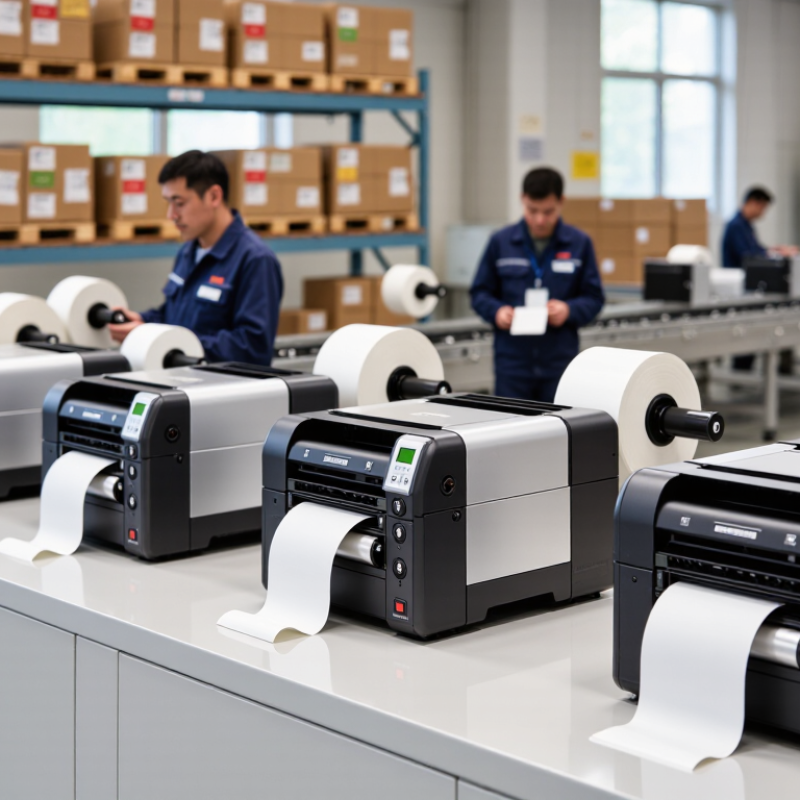
Thermal roll printer production in China combines electronics assembly, mechanical fabrication, and application testing. In manufacturing clusters, suppliers can source motors, sensors, control boards, and molded housings within relatively short distances. That proximity may shorten procurement cycles, though it does not guarantee consistent quality. Small differences matter. A misaligned platen roller can cause faint bands, while uneven pressure may leave gaps in receipts. Assembly teams typically check feed accuracy, print density, cutter operation, and connection stability before shipment. Test records are useful, but only when settings and sample conditions are documented.
Product designs vary by intended use, including checkout counters, ticket kiosks, and mobile service work. Engineers match print width, speed, interface options, and enclosure strength to the working environment. Dust, heat, and frequent paper changes can expose weak points quickly. Thermal paper also needs attention: coating quality and roll dimensions affect output and feeding. Some production lines automate inspection; others still depend on manual checks, which can make results less even. Reviewing test samples under realistic workloads is more informative than relying only on a specification sheet. The sector is capable and fast-moving, yet no single factory process should be assumed to fit every application.
Thermal Roll Printer Manufacturing in China
Representative thermal paper roll widths used across receipt and label printer formats
Common format examples include 57 mm and 80 mm receipt rolls and 110 mm rolls used in some wider-format applications. These are product format widths, not production volumes or market-share figures; supported sizes vary by printer model.
Key Technologies Used in Thermal Roll Printers
Thermal roll printers rely on a small set of tightly coordinated technologies. A ceramic printhead contains tiny resistive elements that heat selected points as the paper moves across a rubber platen roller. Direct thermal media darkens where heated, so it needs no ribbon. Thermal-transfer models instead heat a coated ribbon, depositing ink onto the roll. The choice affects durability: direct thermal labels can fade with heat and sunlight, while transferred images often resist abrasion better. Small detail, big difference.
Grand View Research estimated the global thermal printer market at USD 4.4 billion in 2023 and projected a 5.8% compound annual growth rate from 2024 to 2030. That growth raises practical demands on printheads, sensors, and control firmware. Resolution commonly ranges from 203 to 300 dpi; higher resolution can sharpen tiny text, but it may slow output and increase cost. Gap sensors detect label spacing, while black-mark sensors track printed marks on continuous stock. Firmware must align heat, feed speed, and darkness settings with the chosen paper. A neat specification sheet can still mislead. Humidity, dusty sensors, or uneven rolls may cause faint bars and drifting alignment, so real media testing matters.
Leading Thermal Roll Printer Manufacturers in China
Leading Thermal Roll Printer Manufacturers in China serve a fast-moving market shaped by parcel logistics, retail, and warehousing. China’s State Post Bureau reported 174.5 billion express parcels in 2024, a 21.5% increase from the previous year, in its 2024 postal industry statistics. That volume makes consistent print quality and reliable roll feeding practical priorities. A printer that skips a barcode can slow a packing bench.
When comparing manufacturers, buyers should examine print resolution, supported roll widths, cutter life, connectivity, and spare-part availability. Ask for sample labels printed at the intended speed; inspect small text and barcode edges under ordinary warehouse lighting. Also request documented test conditions, not only headline specifications. A supplier’s quality-control records and repair response times can reveal more than a polished product sheet.
There is no single best configuration. Small details matter. A compact unit may suit a checkout counter, while a metal-framed model may better handle long shifts near packing lines. Yet claims about durability can be difficult to compare when test methods differ. That is worth questioning. Confirm compatibility with existing software and media before ordering, then test a production-size roll through repeated print cycles. These checks help distinguish capable Chinese manufacturers from suppliers whose specifications look stronger on paper than in daily use.
Top Thermal Roll Printer Manufacturers in China - Leading Thermal Roll Printer Manufacturers in China
| Product Segment |
Common Roll Width |
Typical Print Technology |
Common Resolution |
Typical Connectivity |
Common Applications |
| Compact receipt printers |
58 mm |
Direct thermal |
203 dpi (8 dots/mm) is common |
USB; some models offer Bluetooth or serial options |
Mobile sales, small counters, and compact point-of-sale systems |
| Standard POS receipt printers |
80 mm |
Direct thermal |
203 dpi (8 dots/mm) is common |
USB, serial, Ethernet, or combinations, depending on model |
Retail checkout, restaurants, and service counters |
| Portable receipt printers |
Typically 58 mm or 80 mm |
Direct thermal |
203 dpi (8 dots/mm) is common |
Bluetooth or USB; interfaces vary by model |
Delivery receipts, field services, and mobile point-of-sale |
| Desktop label printers |
Media widths vary by model; 4-inch-class models support media up to about 104 mm wide |
Direct thermal; some models also support thermal transfer |
203 dpi is common; 300 dpi is available on some models |
USB is common; Ethernet, serial, or wireless options may be available |
Shipping, inventory, product, and barcode labels |
| Kiosk and ticket printers |
Roll width depends on the printer and kiosk design; 58 mm and 80 mm formats are common |
Direct thermal |
203 dpi (8 dots/mm) is common |
USB, serial, or other integration interfaces, depending on model |
Self-service kiosks, queue systems, and ticket dispensing |
Specifications shown are common market configurations, not rankings or claims about individual manufacturers. Actual supported media, resolution, interfaces, and performance vary by printer model.
Product Range and Capabilities of Major Manufacturers
Chinese thermal roll printer manufacturers typically cover compact desktop units, high-speed industrial printers, and custom-width models. Product options often include direct-thermal and thermal-transfer mechanisms, with resolutions suited to shipping labels, receipts, and small product tags. Some factories also offer cutters, external roll holders, and interfaces such as USB, Ethernet, or Wi-Fi. Check the actual configuration; a feature listed as optional may not come standard.
Grand View Research’s 2023 Thermal Printing Market report estimates the global market at about US$45.8 billion in 2022, with projected growth through 2030. This broad figure includes multiple product types and applications, so it should not be read as a measure of any single manufacturer’s output. For buyers, the practical comparison is narrower: print speed, supported media width, duty cycle, and firmware compatibility. Test these with your own label stock.
Capability claims can look similar on paper. Ask for sample prints using dense barcodes and small text, then inspect edge sharpness and feed consistency. Also request details on printhead life and spare-part availability. A fast machine is not always the best fit. Some published specifications omit test conditions, which makes direct comparisons imperfect.
That deserves attention.